ICT trading was created by Michael Huddleston, also known as the Inner Circle Trader.
👉 It is a trading approach that follows institutional (smart money) behavior.
📌 Core Concept (One Line)
👉 “Track where institutions buy and sell — not retail traders — and enter accordingly.”
🧠 ICT Core Philosophy
❌ Typical Retail Trading
- Support & Resistance
- Indicators like RSI, MACD
✔ ICT Approach
- Liquidity
- Institutional order zones
- Price manipulation (Stop Hunts)
👉 In short:
“Price is not random — it is engineered.”
🔥 5 Key Concepts (Very Important)
1️⃣ Liquidity
👉 The market contains “easy money” to take
- Retail stop losses = liquidity
- Above highs / below lows = stop clusters
👉 Institutions target these areas
2️⃣ Stop Hunt
👉 Price intentionally breaks highs/lows, then reverses
Example:
- Price breaks a high → retail traders go long
- Price drops immediately → stops get triggered
👉 This is a core ICT pattern
3️⃣ Order Block
👉 Zones where institutions have placed large orders
- Last bearish candle before a rally = buy zone
- Last bullish candle before a drop = sell zone
👉 Price often returns to these areas
4️⃣ Fair Value Gap (FVG)
👉 A price imbalance created by strong moves
- A gap between candles where trading was inefficient
👉 Key behavior:
→ Price tends to return and fill the gap
5️⃣ Market Structure
👉 Structure breaks signal direction
- Higher High / Higher Low = uptrend
- Lower High / Lower Low = downtrend
👉 The break of structure = entry signal
📊 Basic Trading Flow (Simplified)
- Identify liquidity zones
- Wait for a stop hunt
- Confirm structure break
- Enter at an Order Block or FVG
👉 This is the core ICT routine
💥 Why People Use ICT
✔ Can trade without indicators
✔ Based on institutional logic
✔ Works for scalping, swing, crypto, indices
⚠️ Reality Check
👉 Honestly:
❌ Difficult for beginners
❌ Highly subjective interpretation
❌ “Perfect in theory, hard in execution”
👉 That’s why
~90% fail to apply it properly
🔥 Final One-Line Summary
👉 ICT = “Entering after institutions trigger retail stop losses and take the opposite side.”
🔥 ICT Practical Setups (2 That Actually Work)
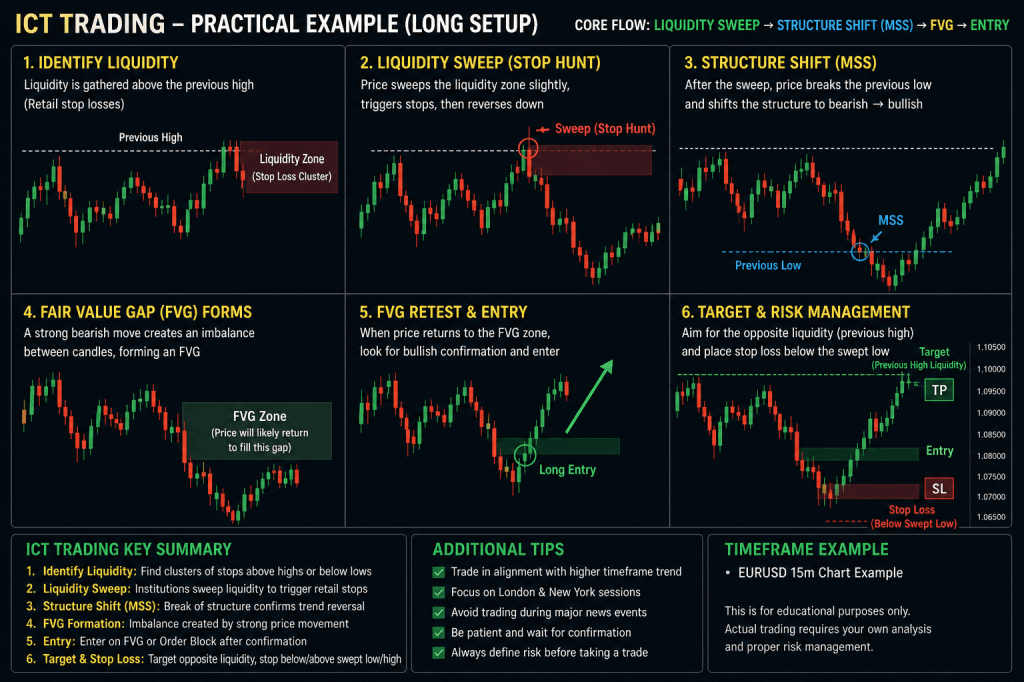
🟢 1. Liquidity Sweep + MSS + FVG (Top Setup)
👉 Best combination of win rate + consistency
📊 Conditions (Flow)
- Previous high/low exists (liquidity)
- Price sweeps it (breaks it slightly)
- Immediate rejection (reversal)
- MSS (Market Structure Shift) occurs
- FVG (Fair Value Gap) forms
🎯 Entry (Key Point)
👉 Enter on the pullback into the FVG
- Entry: 50% of FVG (or FVG origin)
- Stop Loss: Above/below the swept high/low
- Take Profit: Opposite liquidity
💡 Example (Short)
- Price breaks previous high → retail goes long
- Sharp rejection
- Structure breaks downward (MSS)
- FVG forms
👉 Pullback = short entry
🔥 Core Idea
👉 Only trade AFTER the stop hunt
(This is what separates profitable traders)
🟡 2. Order Block + Liquidity Sweep
👉 More advanced / better risk-to-reward
📊 Conditions (Flow)
- Strong move leaves behind an Order Block (OB)
- Price performs a liquidity sweep
- Price returns to the OB
🎯 Entry
- Entry: Inside OB (preferably 50%)
- Stop Loss: Outside OB
- Take Profit: Opposite liquidity
💡 Important
👉 OB alone = ❌
👉 Must be used AFTER a liquidity sweep
🔴 Why 90% Lose (Critical)
❌ Enter without a sweep
❌ No structure confirmation
❌ Random OB / FVG usage
👉 Result = gambling
⚡ Execution Filters (Non-negotiable)
✔ Kill Zones (Timing)
- London Open
- New York Open
👉 Trade only during these sessions
✔ Directional Bias
- Confirm higher timeframe (1H / 4H)
👉 Trading against it = low probability
✔ Avoid News
- CPI / Interest Rates / NFP
👉 Stay out before major releases
💰 Money-Making Formula
👉 Liquidity Sweep → MSS → FVG → Entry
Master just this, and you’re ahead of most ICT traders.
🔥 Final Truth
👉 “Enter after retail traders get stopped out.”
 Olymprop | Olymptrade
Leave a comment